
Rotobrush Air Duct Cleaning in Manchester: A Homeowner’s Guide
The rotating brush that cleans your ducts was designed around flexible duct. That’s the detail most Manchester homeowners never hear before they book. If your house has older rectangular sheet metal runs in a basement or between joists, the tool that cleans flex duct beautifully can leave the flat top of a metal trunk untouched, because a spinning brush can’t press into a surface it never reaches. Rotobrush equipment is genuinely effective in the right configuration. The trick is knowing which configuration you have. If you’d rather have someone assess it for you, call (833) 865-1627.
What Rotobrush actually does inside your ductwork
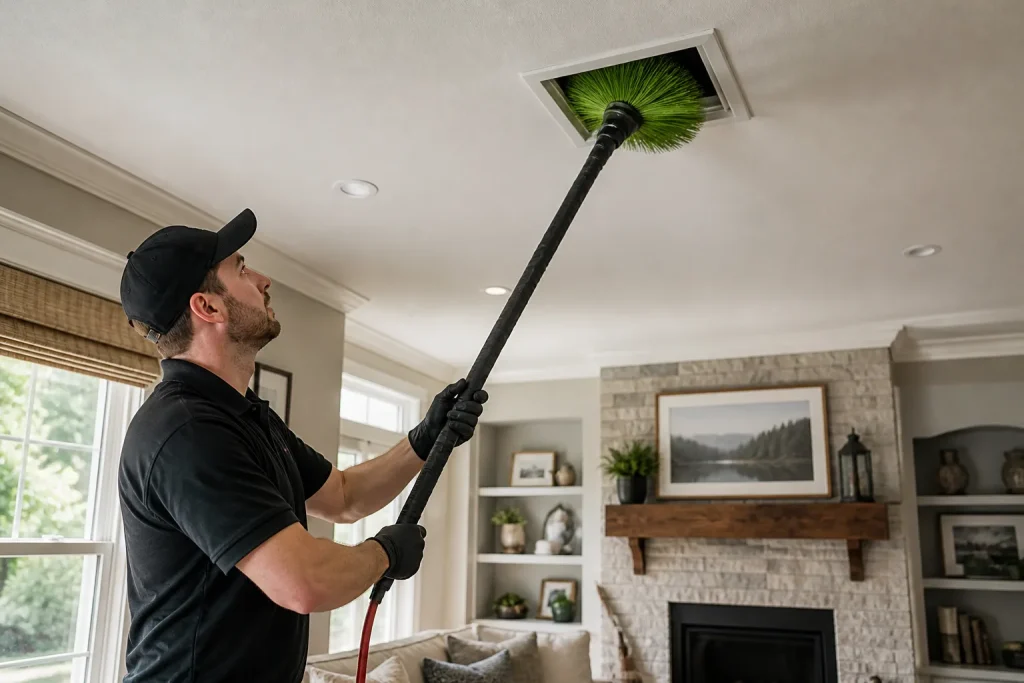
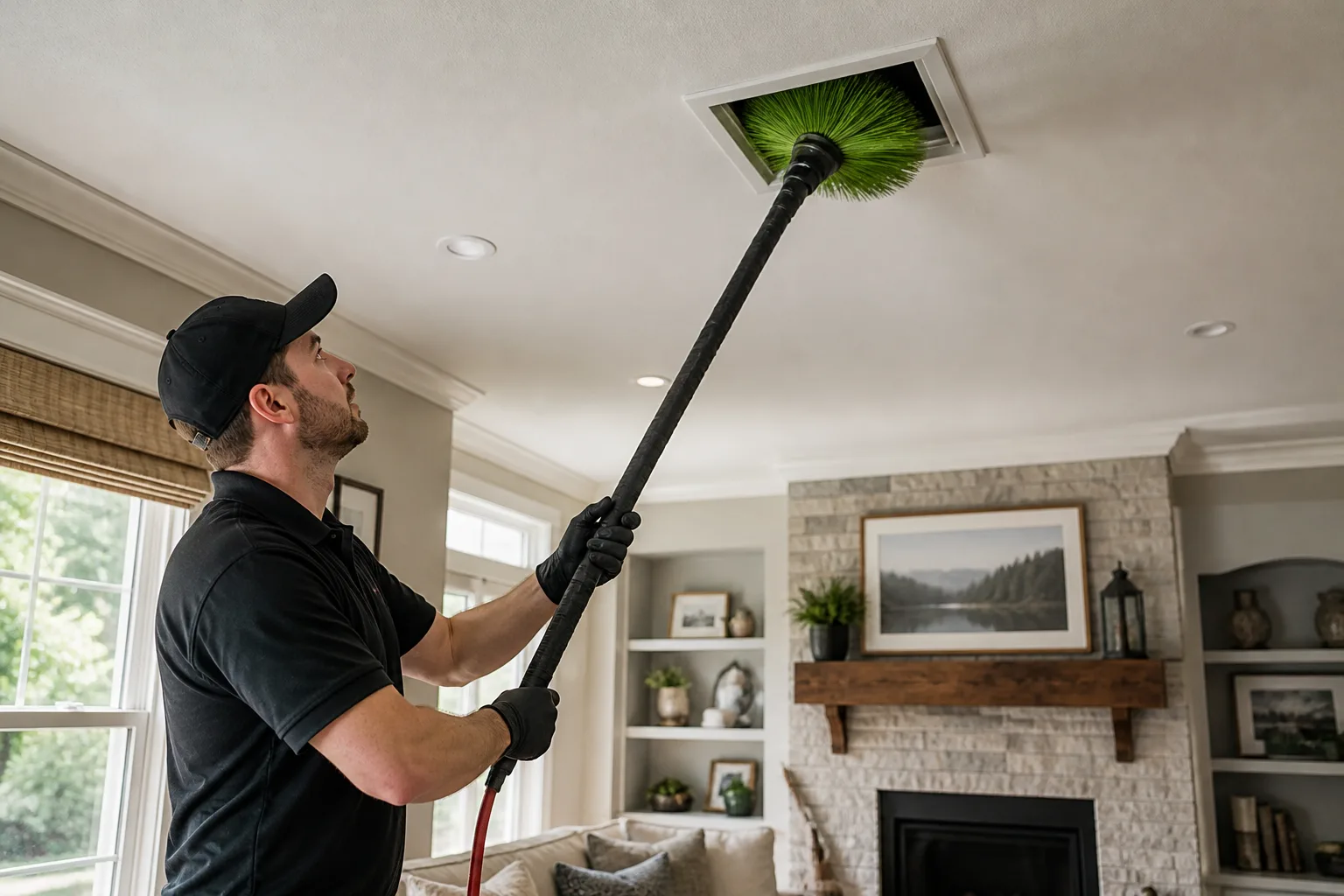
Rotobrush is a brush-and-vacuum system in one unit. A flexible whip with a rotating brush head feeds down a branch run, scrubs the duct walls as it spins, and a vacuum pulls the loosened debris back toward the machine at the same time. That combination of agitation plus extraction is the part that matters, and it’s exactly what the NADCA standard asks for: you don’t just knock dust loose, you capture it.
Here’s what the design is optimized for:
- Residential branch runs, typically 4 to 8 inches in diameter
- Flexible duct, where the brush can follow the spiral and reach the full inner circumference
- Moderate buildup of household dust, pet hair and lint
- Single-story and straightforward two-story layouts where runs are short and accessible
What it isn’t designed around: long, flat main trunk lines. A round brush in a rectangular metal trunk contacts the sides and the bottom but skips the wide flat top panel, and that’s often where the heaviest dust settles in an older Manchester home. We use Rotobrush and Nikro professional systems because they’re the right tool for a lot of jobs. They’re not the right tool for every job, and a technician who tells you otherwise hasn’t looked at your ductwork.
When a truck-mounted negative-pressure system does the job better
Truck-mounted negative pressure works differently. A large vacuum unit parked outside connects to the main trunk and pulls the entire duct system into negative pressure, so every opening, every branch and every seam draws air inward. A technician then agitates the ducts from inside. Debris doesn’t just get scrubbed loose; it gets pulled out of the house in one direction, at high volume, with no chance to settle back into a room.
That setup outperforms a portable brush system in a few specific situations:
- Long main trunk lines. A trunk running the full length of a basement in a 1960s Manchester split-level holds far more debris than a short branch run, and negative pressure moves that volume.
- Heavily contaminated sheet metal. Decades of settled dust on flat galvanized panels needs sustained suction, not a brush pass.
- Post-renovation debris. Drywall dust, sawdust and construction grit are fine particles that a brush stirs up and a smaller vacuum struggles to capture fast enough.
None of this makes Rotobrush a bad choice. It makes it a specific choice, and the honest answer for many Manchester homes is that you need the extraction capacity of a larger system alongside the brush agitation.
What the NADCA standard actually requires, and how to check any provider against it
The NADCA standard for duct cleaning doesn’t name a brand. It describes a process: source removal through mechanical agitation combined with continuous negative pressure and HEPA filtration, so contamination is captured rather than redistributed into your living space. That’s the benchmark. Any equipment setup can meet it or fail it depending on how it’s run.
When you’re evaluating a provider, ask these questions before you book:
- What’s the CFM rating on your extraction vacuum? Higher airflow captures more airborne debris. A small portable unit running at low CFM can’t keep up with what a brush loosens.
- How is the vacuum filtered? You want HEPA containment and a sealed collection path. Abatement Technologies filtration equipment is the kind of compliance-grade setup you’d expect to see in remediation work, and it’s the standard to hold a cleaning to.
- Is there negative pressure on the system while you work? If not, dust goes into the room, not out of it.
- Do you do a before-and-after inspection? Photos of your own ducts show whether the work happened.
If a provider can’t answer the first two, that’s your answer about the other two.
Manchester and Southern New Hampshire housing stock: which method fits which build
Manchester’s housing stock splits into recognizable eras, and each one tends to come with its own duct configuration.
1960s and 1970s builds often have rectangular galvanized sheet metal trunks in the basement with short round branch runs off them. The trunks are long, flat-topped and prone to heavy settled dust. These homes usually benefit from negative-pressure extraction on the main line combined with brush agitation on the branches, and the seams deserve a look because tape and mastic from that era fail.
1980s and 1990s builds more often use flexible duct for the branch runs, sometimes with a metal trunk. This is where Rotobrush equipment is closest to purpose-built: the brush follows the flex spiral, contacts the full circumference, and the vacuum captures what it loosens.
Renovated older homes anywhere in Manchester carry a mixed system: original metal sections spliced to newer flex, sometimes with disconnected runs where a remodel moved a wall. That’s a repair question, not just a cleaning one.
That last point is where we differ from cleaning-only operations. We repair ducts, not just clean them. A disconnected run or a leaking seam means you’re paying to clean a system that will re-contaminate itself. If you’re weighing the two services, our air duct cleaning page covers the standard process, and our Suncook page shows how we scope a typical job. Familiarity with whole-home air quality brands like Honeywell and Aprilaire also helps us recognize when a duct problem is really a filtration or humidification problem.
Questions to ask before you book a Rotobrush provider in Manchester
Equipment matters, but the technician running it matters more. A few direct questions separate a thorough job from a hose through the vents.
- “Will you inspect and photograph the ducts before and after?” Yes means they’re accountable for the result.
- “What’s your extraction CFM and how is it filtered?” You’re looking for a real number and HEPA containment.
- “How do you handle the main trunk versus the branches?” A clear method answer, not a shrug.
- “What if you find a disconnected or damaged run?” The right answer is that they can repair it. If they can only clean around it, that’s worth knowing now.
- “Is the price per system or per vent?” Per-vent pricing is how a modest quote becomes a large invoice once the technician is on site. We work on one flat price per system, agreed before any work starts.
One small grace note: if a provider’s answer to “what equipment do you use” is a long brand monologue and nothing about method, that’s a red flag dressed in a uniform. Ask about the process.
When to call a pro instead of guessing
If your ducts are visibly clogged at the registers, if a room never heats or cools the way the rest of the house does, if a recent renovation left drywall dust in the system, or if your dryer is taking two cycles to dry a normal load, those are signs worth a professional look. Dryer vent cleaning is its own safety issue: lint accumulates in the vent run and restricts airflow, and a restricted vent is a fire risk, full stop. We treat it as a dedicated service because it deserves the same systematic approach as full duct work.
Related services in Manchester: dryer vent cleaning and Grafton Air Duct Cleaning for the full picture of what we do. If you’re not sure which service you need, start with an assessment.
The Bottom Line
Rotobrush equipment is effective, well-made and the right tool for many Manchester homes, especially those with flexible branch runs from the 1980s and 1990s. It’s less suited to long rectangular metal trunks and heavy post-renovation debris loads, where truck-mounted negative pressure pulls more out. The standard that matters is NADCA’s: agitation plus continuous extraction with HEPA filtration. Ask any provider about their CFM rating and filter containment before you book, and ask whether they can repair a disconnected run rather than clean around it.
If you’re in Manchester and want a straight assessment of which method fits your ductwork, Grafton Air Duct Cleaning offers free estimates. We use professional-grade Rotobrush and Nikro equipment, we repair ducts rather than just clean them, and we agree one flat price per system before any work starts. Call (833) 865-1627. We answer 24/7. Fast dispatch from 7am to 7pm, Sunday through Friday. Our technicians have up to experience, and estimates are always free.
Frequently Asked Questions
It depends on your ductwork, not on the brand. Rotobrush excels on flexible branch runs because the rotating brush reaches the full inner circumference while the vacuum captures loosened debris. Truck-mounted negative pressure outperforms it on long rectangular metal trunks, heavy contamination and post-renovation debris, where sustained high-volume extraction matters more than brush contact. Many homes need both approaches. Call (833) 865-1627 for an exact quote; estimates are free.
We price per system, not per vent, and the written estimate sets the final price before any work begins. That structure exists because a per-vent quote encourages a low teaser number that grows once the technician counts your registers on site. Ask any Manchester provider whether their price is per system or per vent, and get it in writing. Call (833) 865-1627 for an exact quote; estimates are free.
You ask for before-and-after photos of your own ducts, and you ask what CFM their extraction vacuum runs at and how it’s filtered. A provider who can show you the inside of your system before and after, and who can explain their containment setup, is accountable for the result. If those questions get vague answers, that tells you something. Call (833) 865-1627 for an exact quote; estimates are free.
There’s no fixed calendar answer. A home with pets, allergy sufferers, recent renovation work or visible debris at the registers needs attention sooner than a clean home with a maintained filter. A professional assessment should tell you what your system actually looks like rather than quote a schedule. If your dryer is taking longer than it should, that’s a separate and more urgent signal for dryer vent cleaning. Call (833) 865-1627 for an exact quote; estimates are free.
Written by the team at Grafton Air Duct Cleaning.
Need Air Duct Cleaning Help?
Call Grafton Air Duct Cleaning - licensed & insured, with free written estimates in Manchester.
(833) 865-1627